
Editor’s note: The City of Watonga will hold information sessions on the hospital question, much the same as the ones concerning the recent tax question. They will be held at 6 p.m. Monday, March 20 and 6 p.m. March 26 at City Hall, 410 W. Main Street, Watonga.
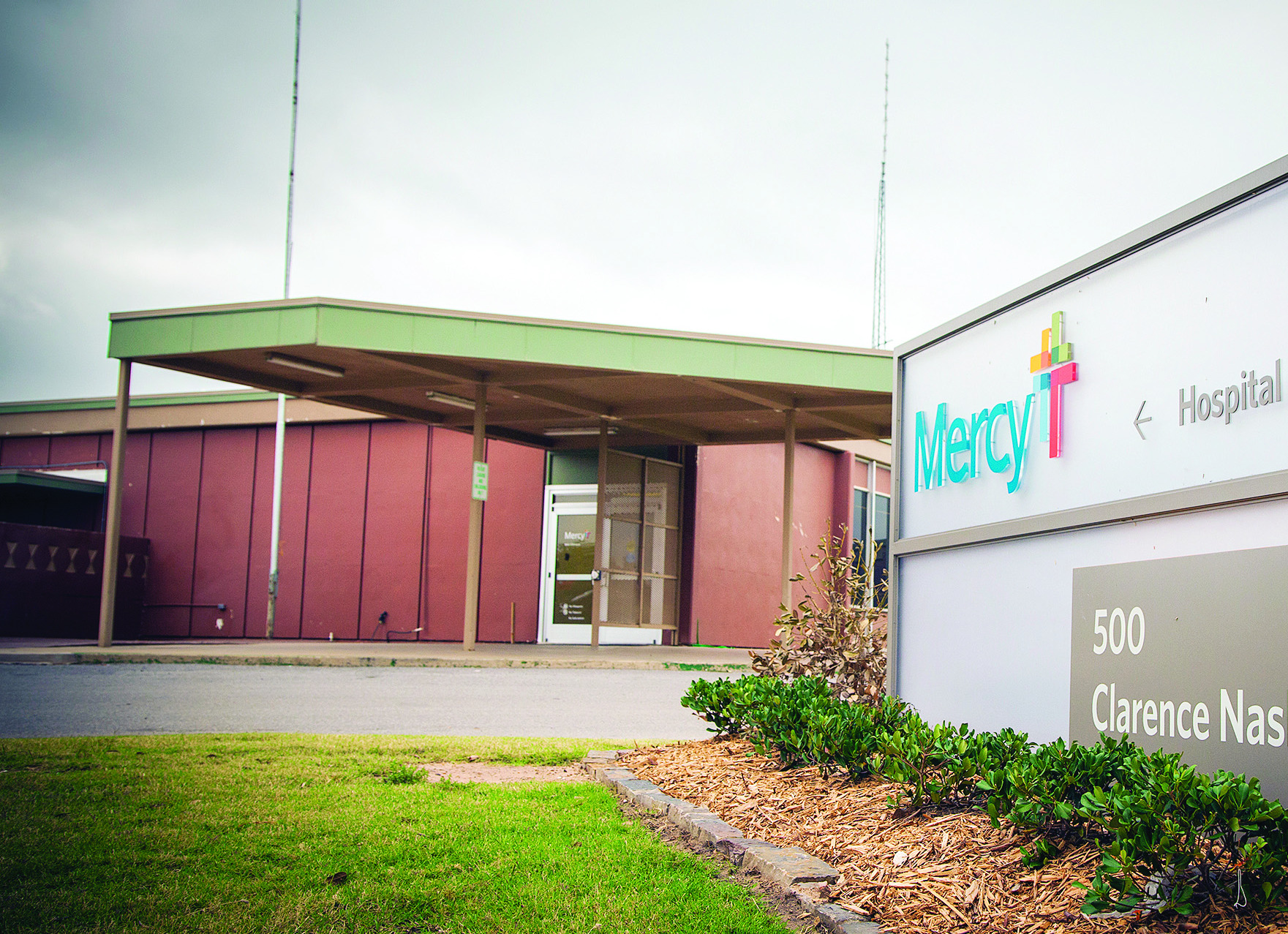
The April 4 ballot will be a busy one in Blaine County. Besides municipality races, it will ask residents of the City of Watonga whether they are willing to continue to support Mercy Hospital Watonga with two, one-cent sales taxes.
Those sales taxes were most recently extended in 2018. Since that time, the city has collected $4.665 million for the facility. Some residents are fully on board with the support the hospital receives, while others feel the city sales taxes of 10.38 cents on each dollar is too high.
That rate breaks out as 4.5% to the state, .875% to the county, and 5% for city sales taxes. That city sales tax breaks down further into 2% to the hospital, 1% to the capital improvements fund recently passed and 2% for city operations. The town ranks in the top 8% of tax rates statewide.
What does the community get for its money?
Annually, the hospital pays for the electronic health record subscription which allows other facilities to access records and tests done at the Watonga facility. Mercy also pays to maintain the HVAC system, an aging heat and air conditioning system that keeps the building climate controlled. It employs 51people. Since 2018 Mercy has bought equipment for pediatric therapy services, lab equipment, cardio therapy equipment, new treadmills, ceiling and lighting through the entire building, renovation of the skilled nursing room, new beds for patient rooms, radiology equipment, a portable ultrasound, telehealth equipment and site preparation for the installation of a new CT scanner. Essentially, the healthcare company says the tab for selfpaid improvements is running close to $300,000 per year over the last 10 years. These purchases are, according to the company, paid for out of its own coffers, because the costs aren’t covered by the dedicated sales tax dollars. And those numbers don’t include the more than $460,000 in unreimbursed charity care Mercy provides to indigent patients in the community.
The tax money, according to hospital administrator Bobby Stitt, goes toward operations of the facility, the day-to-day running of Watonga Mercy.
Those expenses could include salaries, maintenance of the equipment such as x-ray machines, building maintenance, power, water and telephone and internet service. It doesn’t stretch to capital improvements like a new CT scanner.
“Mercy looks to remain relevant in a community,” Stitt said. “This has been a great relationship with the city and we are looking forward to continuing that relationship.”
That said, Stitt knows the facility has to continue to prove its value and viability in the community.
Just the economic impact of having the business in town is considerable, he said. There are the employees, most of whom live in town and shop locally, buying gas, groceries and meals. They may own homes and pay property taxes that support the schools.
The hospital pays an enormous power bill each month to the city of Watonga. If Mercy left, those impacts would either cease or be picked up by another company. And while Mercy would, Stitt said, cooperate with changing the facility to another healthcare company to run the Watonga facility, that new company would have to bring in its own equipment, since what Mercy bought would be transferred to another Mercy-operated hospital or clinic.
“Losing the tax incentive would be detrimental and financially unfeasible for Mercy to continue to operate a 25-bed hospital that requires around the clock staffing in Watonga. Mercy is asking Watonga taxpayers to re-approve the two one cent sales tax incentives on the ballot … so Mercy can continue to provide highquality, low-cost health care to the Watonga community. During the past 10 years, Mercy has had no rate increases. Re-approving the sales tax incentive will only maintain the same rate that has been in place for a decade,” wrote Meredith Huggins, a senior media relations and communications specialist for Mercy, when she was asked about the upcoming question last year.
“The cost of health care continues to rise as inflation has increased around 9% across the nation in the last year alone,” Huggins continued. “According to publicly available data, Mercy consistently delivers some of the highest-quality care to patients across Oklahoma at the lowest cost and we want to be able to continue doing that for the Watonga community. Mercy remains dedicated to the people of Watonga and hopes to continue to provide exceptional health care for years to come thanks to the ongoing support of the Watonga community.”
The relationship between the community and Mercy is not the same as that found in Kingfisher or Guthrie. In Kingfisher, the voters passed a bond issue to construct the new facility, while in Guthrie, the hospital is owned by Mercy itself. Here, the city owns the building. Mercy’s unreimbursed maintenance on the building is like a renter repairing the roof on the landlord’s house.
At a recent appearance at the Watonga Kiwanis Club, Stitt said Mercy loves being part of the community. “It’s a great partnership and candidly the sales tax has been part of the success of that partnership. Failure to pass (the sales tax) would cause a reevaluation of that partnership,” he said.