
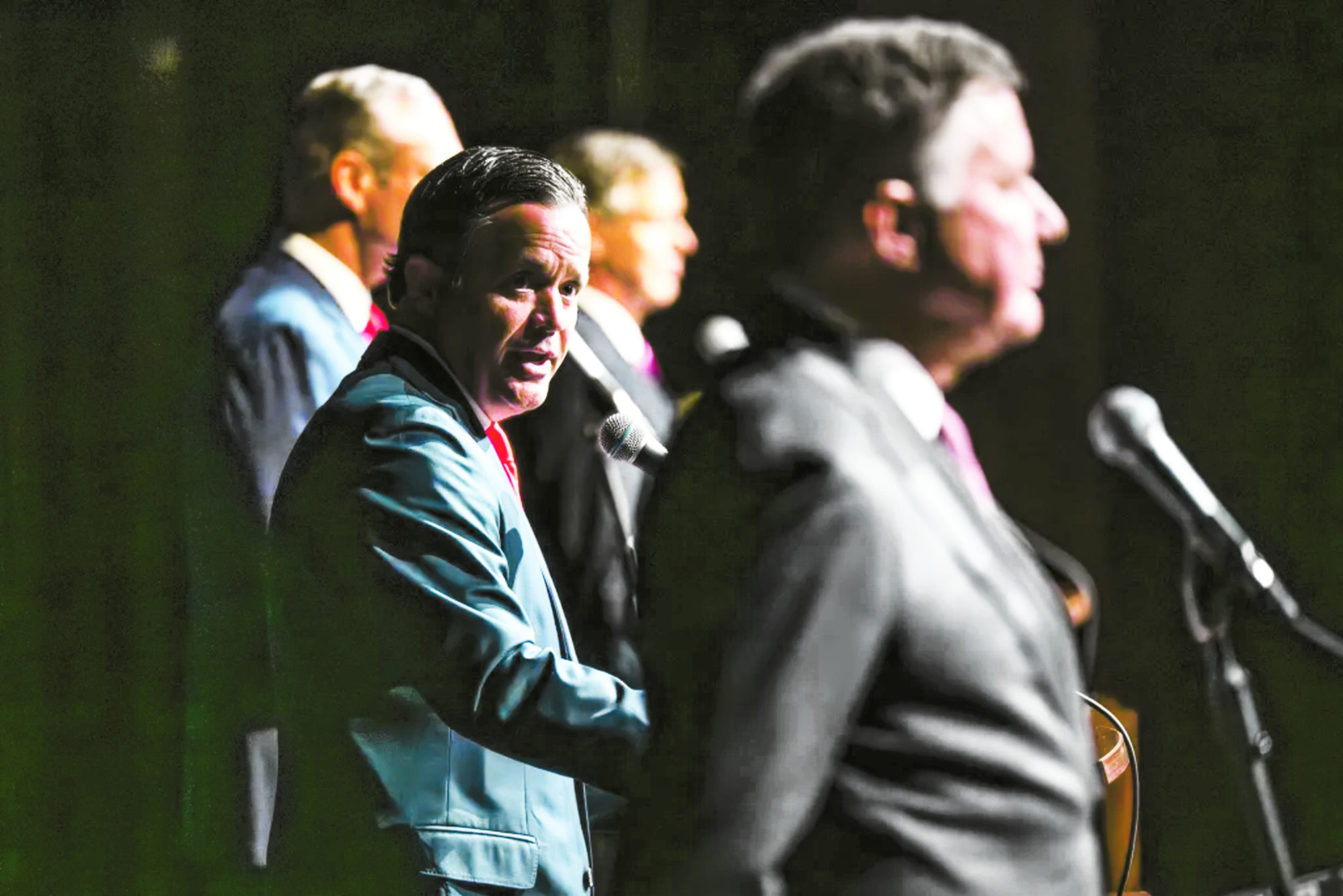
In partnership with NonDoc, The Frontier fact-checked some claims Republican gubernatorial candidates made during the May 28 debate at Cameron University in Lawton. Candidates Gentner Drummond, Chip Keating, Charles McCall and Mike Mazzei qualified for the debate based on their performance in a recent poll.
The Frontier used interviews, public records and news archives to verify information.
Claim: Drummond has no inherited wealth.
Drummond said: “At 14, I went to court and was emancipated, I moved out of my household, and I’ve disclaimed any inheritance. Everything I have is made by my own sweat, hard work and grit now.”
Fact check: Mostly false Records show Drummond refused at least part of his inheritance from his father, but some land in Osage County was still passed to him from his family, making the claim that he has no inherited wealth untrue.
Gentner Drummond is a descendant of the banker and rancher Frederick Drummond, a Scottish emigrant who arrived in Osage County in the late 1800s and helped establish the town of Hominy as a commercial center.
A 2025 state financial disclosure form shows that Gentner is at least a partial owner of Drummond Ranch LLC, which holds thousands of acres of land in Osage County. Property records show several large tracts of land were transferred over the years to Drummond Ranch LLC from the Leslie F. Drummond and Sons Partnership. Gentner’s father, Leslie Drummond, died in 2010, and Gentner and his brother, Jonathan Drummond, were in line to inherit most of their father’s estate, according to probate court records. But the brothers renounced 40% of the Leslie F. Drummond and Son’s Partnership, as well as part of their grandmother’s estate, giving those assets to their mother, according to a 2011 court order. Gentner and his brother were to inherit any remaining property. Real estate records show that some land held by Gentner’s mother was later transferred to Drummond Ranch LLC around the time of her death in 2017.
Drummond has also grown his personal wealth through ownership in several businesses apart from his family’s ranching operation, including a law firm, Blue Sky Bank, Postoak Lodge & Retreat and Drummond Communications. He consistently said over the years that he was legally emancipated at age 14 to purchase his first piece of land. He said in a 2022 Tulsa World article that the purchase involved land that his family had leased for 75 years. Drummond’s campaign said he was emancipated in 1977, but that court records to prove this are only available on microfiche. -Brianna Bailey Claim: Mazzei never supported the national popular vote.
Mazzei said: “Let me be clear: I never supported the national popular vote. And I never voted to get rid of the Electoral College.”
Fact Check: Mostly false Mazzei voted for Senate Bill 906 in 2014, which would have awarded Oklahoma’s electoral votes to the winner of the national popular vote once states with a majority of electoral votes passed similar measures. The bill was labeled as an “Agreement Among the States to Elect the President by National Popular Vote.”SB 906 passed out of the Senate but was not heard in the House.
As of April, 19 jurisdictions have joined the National Popular Vote Interstate Compact. The compact would not get rid of the Electoral College, but could effectively invalidate it if jurisdictions with at least 270 electoral votes join.
“The bill in question would not have abolished the Electoral College,” said Andrew Speno, a spokesperson for Mazzei’s campaign. “Twelve years ago, Mike, along with many of his conservative colleagues, misinterpreted the intent of the bill. Once it was clarified, they actively worked to quash the bill before it went to the House.”
-Brianna Bailey Claim: The largest tax increase in state history was House Bill 1010XX, passed under McCall’s leadership as House Speaker in 2018, and oil and gas executives warned that its passage would have serious consequences for the state’s energy industry.
Keating said: “The point is that is the largest tax increase in state history. Larry Nichols, Harold Hamm both warned the legislators that they would regret that decision.”
Fact check: Mixed
The Legislature approved House Bill 1010XX in 2018 to fund a teacher pay raise. It was the first time the Legislature had fully voted to raise taxes since 1990, which was also to fund education.
McCall voted in favor of the bill. At the time, the state had repeatedly struggled with massive budget deficits and was staring down the barrel of a teacher walkout over low pay. House Bill 1010XX, which included raising taxes on oil and gas production, was anticipated to generate more than $474 million in state revenue in its first year.
Increases in oil and gas drilling and production resulted in the state receiving significantly more in revenue than anticipated after the tax increase, likely making House Bill 1010XX one of, if not the largest, tax increases in state history. Most of the state’s energy industry opposed the tax increase, with Continental Resources founder Harold Hamm calling the tax increase a “deterrent” to Oklahoma oil and gas activity. The state’s major energy leaders unsuccessfully offered their own revenue plan that included a smaller increase to the gross production tax. That measure failed to garner enough votes for passage. At the time House Bill 1010XX was making its way through the legislative process, the oil industry was also fighting in court to prevent a ballot measure that would have raised the gross production tax on all wells even further. In early 2026, Devon Energy, following a merger with Coterra Energy, announced it was moving its headquarters to Houston but would keep a significant presence in Oklahoma. That announcement was followed by an announcement that Expand Energy, formerly Chesapeake Energy, would also be moving its headquarters to Houston. Though neither company said the move to Houston was a result of the gross production tax increase eight years earlier, the Oklahoma Petroleum Alliance claimed it was one of the reasons for both companies’ departure. -Clifton Adcock Claim: As House Speaker, McCall passed the largest tax cut in state history.
McCall said: “We cut personal income tax, we cut the corporate income tax, we eliminated the grocery tax, the franchise tax, and the marriage penalty.
That’s where the largest tax cut in state history came, not these other bills that have been thrown around.”
Fact check: Mostly true In 2024, McCall coauthored House Bill 1955, ending the state’s portion of the sales tax on groceries and reducing state revenue by over $400 million per year. State leaders at the time said this was the singlelargest tax cut in state history, according to local new reports and press releases.
McCall’s campaign said it knew of no other single tax cut that had a larger fiscal impact.
McCall also supported other major tax-reduction measures in recent years, including bills to cut individual and corporate income taxes in 2021 and end the franchise tax in 2023.
-Kayla Branch Claim: Mazzei once proposed the largest tax increase in state history.
McCall said: “He introduced the largest tax increase in state history to raise your personal income taxes, a $539 million fiscal impact.”
Fact check: Mostly true Mazzei’s bill, Senate Bill 1073, was filed in 2016 and would have increased Oklahoma’s top income tax rate from 5% to 5.25%, reversing a tax cut that had already taken effect and generating an estimated $539 million in additional revenue over two years.
However, it’s not clear if it would have truly been “the largest tax increase in state history” at that time. Oklahoma’s 1990 education reform package included a $560 million tax increase over five years, according to KGOU and Oklahoma Policy Institute.
-Dylan Goforth Rating system: True: A claim that is backed up by factual evidence
Mostly true: A claim that is mostly true but also contains some inaccurate details Mixed: A claim that contains a combination of accurate and inaccurate or unproven information True but misleading: A claim that is factually true but omits critical details or context Mostly false: A claim that is mostly false but also contains some accurate details False: A claim that has no basis in fact The Frontier is Oklahoma non-profit Journalism. Donate now to support unbiased journalism. The Frontier launched in 2015 as Oklahoma’s premier investigative outlet.
Reach Frontier staff by email at info@readfrontier. com