
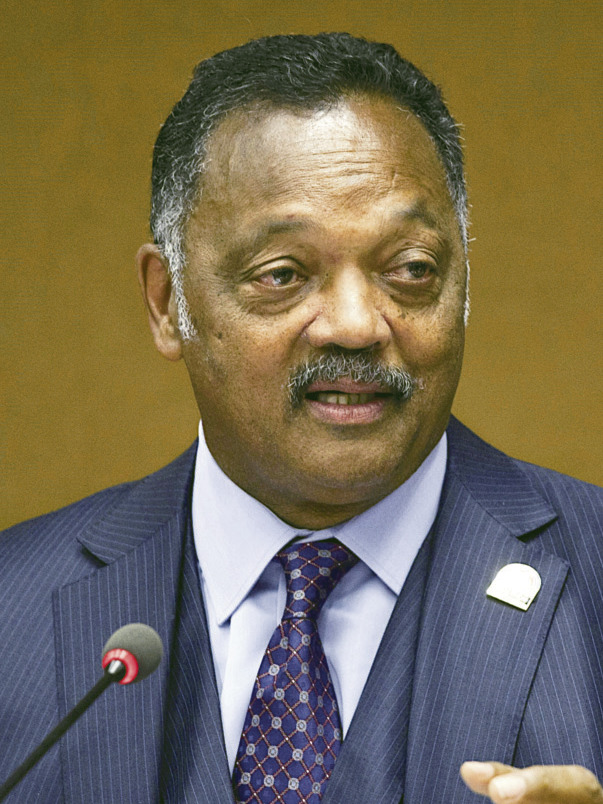
The Reverend Jesse Jackson died February 17 at age 84.
Jackson, an advocate for civil and human rights and a politician, was born in Greenville South Carolina and was the founder of multiple organizations that later merged to become the PUSH coalition.
Jackson was a graduate of North Carolina Agricultural and Technical University, where he earned his bachelor's degree, and the Chicago Theological Seminary to become an ordained Baptist minister. He was a presidential candidate in 1984 and 1988 and finished as runner-up in a tight run for the Democratic nomination in ’88, which he lost to Michael Dukakis.
Jackson was known for his fiery, sermon-like speeches, extorting his followers to never give up hope for change in what he saw as political, legal and economic inequalities targeting people of color. His own heritage included Native Americans, enslaved African-Americans, Irish plantation owners and a sheriff who served in the Confederacy during the Civil War.
He attended a segregated grade school, walked away from a minor league baseball contract to play football at the University of Illinois and left that largely White college to transfer to historically Black North Carolina A&T.
He began working with Martin Luther King Jr. and soon earned a role in the Southern Christian Leadership Conference. He worked in the economic division of the SCLC serving as the national director of Operation Breadbasket, which staged boycotts by Black consumers to pressure businesses to hire Black employees and purchase goods and services from Black-owned companies.
Jackson was with King when he was assassinated on April 4, 1968, although his claims he was the last person to speak to the civil rights icon and that he cradled King in his arms as King died have been disputed by others who were also present.
In the 1970s Jackson went on to organize a Black Expo in Chicago, promoting the political and economic power of the African-American community. By 1978, he was calling for a bridge between Blacks and the Republican Party. He said each side needed the other to have viable alternatives and a chance at national office.
Even after he left the national political spotlight, Jackson remained a heavy hitter. In 1983, he made a trip to Syria where he appealed to the Syrian president for the release of Naval Lt. Robert Goodman, who had been shot down over Syrian airspace. The appeal was successful and Goodman was freed. In 1984, he made a personal visit to Fidel Castro in Cuba, securing the release of 22 Americans being held there and in 1991, he convinced Saddam Hussein to release foreigners in Iraq being held as human shields, resulting in freedom for 20 Americans and several Brits.
Jackson long railed against Apartheid and was on hand when Nelson Mandela was freed from a South African prison and negotiated the release of three American captured in Yugoslavia as part of a peacekeeping unit.
Later in life, Jackson remained a vocal and powerful champion of education and health care reform and a critic of the growth of prisons as an industry.
He was a staunch supporter of Barack Obama and was famously photographed in tears moments before Obama’s victory speech in November 2008.
As late as 2021, Jackson was still in the forefront of political battles, being arrested as he protested for Congress to raise the federal minimum wage to $15.
He was diagnosed with Parkinson’s Disease in 2017 and he was severely affected by two bouts with COVID-19. His Parkinson’s diagnosis was later revamped to progressive supranuclear palsy, a degenerative disorder that mimics Parkinson’s.
He was discharged from an acute nursing facility in December 2025 and died at home in Chicago on February 17.