
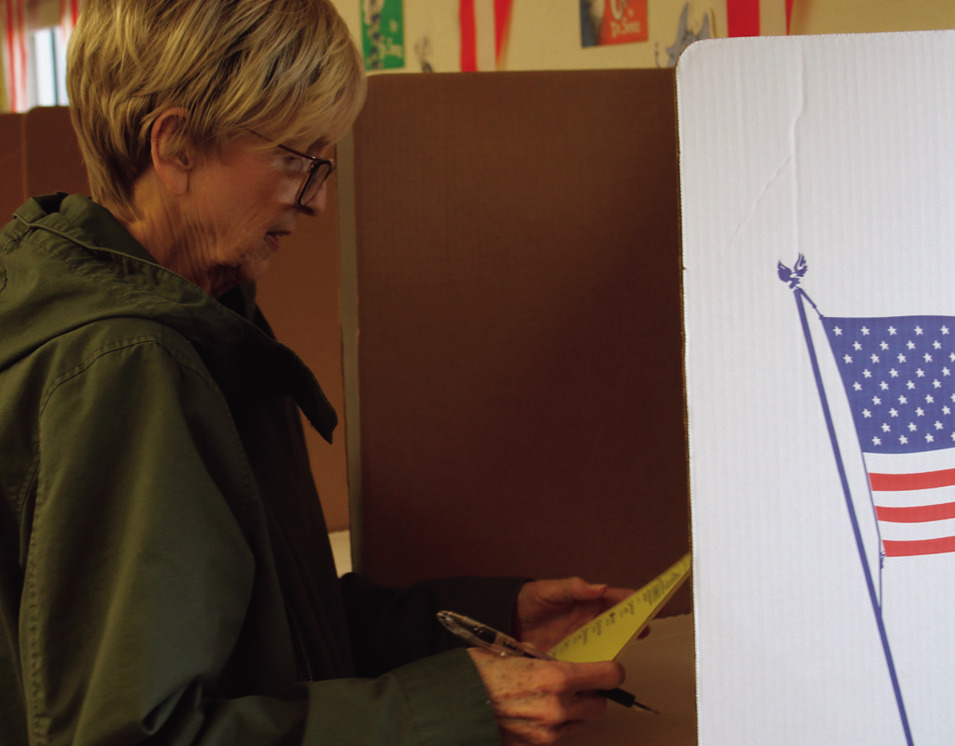
June 16 is the Oklahoma Primary election.
In Blaine County, voters will choose candidates for the county treasurer and county commissioner seats #1 and #3.
Contestants are Sabra Barnes, the challenger and Crystal Campos-Perez, the incumbent, for treasurer, Darryl Hicks, the incumbent, and Chad Scheihing, the challenger in District #1 and Tracy Matli, the incumbent, and Thad Schenk, the challenger in District # 3.
The treasurer and District #3 seats are winnertake- all; the winner in District # 1 will face former commissioner Mike Allen in the November general election.
Of course, there are many more names on the ballot.
The choices are presented by party and as they appear on the sample ballots.
On the Democratic ticket for governor, voters may choose Cyndi Munson, Connie Johnson or Arya. Not a misprint, just Arya.
On the ticket for superintendent of public instruction are Craig McVay and Jennettie Marshall.
Vying for Corporation Commissioner are Harold Spradling, Donald Anthony Clytus and Rhonda Eastman.
Seeking the U.S. Senate seat are N’Kiyla Jasmin Thomas, Jim Priest, Troy Green, Ervin Stone Yen and R.O. Joe Cassity Jr.
Running for the U.S. House of Representatives are Jules Roberson and Suzie Byrd.
The ballot you receive may have the candidates in different order depending on what precinct in which you vote.
for District #3 are incumbent Frank Lucas and challenger Wade Burleson.
State Senate seat District # 26 became vacant because Darcy Jech has reached his term limit. Running to fill the seat are Jessica Winegeart, Rich Koch and Brady Butler.
With so many candidates in the field for various political seats, a runoff is likely to determine who will face the candidate from the opposing party in November.
The runoff will be held August 25 and the general election will be on Nov. 3.
Also on the June ballot is State Question 832, whether the state shall implement a raise in the minimum wage.
If passed the measure would increase the minimum wage to $9 increasing annually by $1.50 per hour annually for a final rate of $15 per hour by 2029. After 2030, there would be a cost-of-living adjustment annually tied to the federal consumer price index.
The measure does not exclude formerly exempt minimum wage earners such as part time employees, those under age 18, farm or agricultural workers, feedstore employees, domestic servants, or newspaper carriers or vendors.