
Concluding this series as part of the National Preservation Month, we highlight the 1893 stacked-wood jail now on the property of the Ferguson Home Museum. This jail served as the Watonga City and Blaine County jails. This jail, and the one in Geary, were built by the Pettis Brothers, Alonza and Lorenzo, respectively, according to Walt Pettis, a relative of the brothers. There are few of these wooden jails that are extant. Fewer still are in their original location and included in the Oklahoma History Survey of Early Tiny Jails or Calabooses. OK History Calabooses Abandon OK Jails.
We know about early prisoners in the Watonga Jail from Mrs. Elva Ferguson’s Book “They Carried the Torch: The story of Oklahoma’s Pioneer Newspapers” and from the original jail log in the museum. One of the first prisoners was Howling Wolf. The jail log shows he was interred April 15, 1893, charged with rape. Howling Wolf was 14 years old when he and his father defended their people against the Sand Creek (Colorado) Massacre in 1864. In 1875, he was part of the 33 Southern Cheyenne (and 38 from other tribes) imprisoned at Ft. Marion, Florida. He became an accomplished artist using ledger paper (rather than buffalo hides). After three years in prison, he returned to Oklahoma. His 1893 arrest prompted concern by the Cheyenne in Oklahoma Howling Wolf Wikipedia. Campfires and drums around Watonga prompted citizens to take refuge in the courthouse and to send for the cavalry at Ft. Reno. Howling Wolf escaped jail in another county. He failed to appear for court repeatedly and was never prosecuted.
Mrs. Ferguson writes about Conrad Maas (Maase), a major in the German army and of royalty. He and his wife immigrated to the Bridgeport area in Blaine County. He killed his wife and hid her body in a gruesome way Oklahoman McAlester News. The Blaine County Jail housed him multiple times (one entry is Mar. 9, 1897) as he was shuttled between Kansas, Ft. Reno and finally the state prison in McAlester. He demonstrated artistic painting abilities. He painted large murals at the mess hall at Big Mac, and many smaller paintings. Recently a woman came from Stillwater to see the jail; her grandfather had paintings from Maas. Maas’s murals are being restored.
Who will step up to provide preservation for this important 133-yearold landmark? Perhaps the city police force, or the county sheriff’s office?
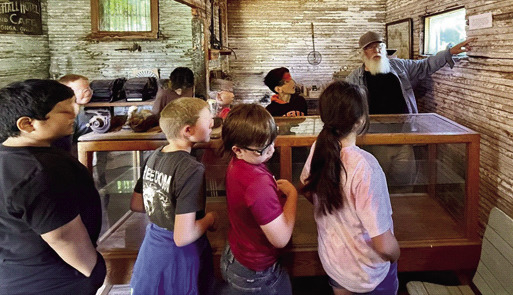
BELOW Third graders learn about the prisoner graffiti inside the Watonga/Blaine County jail.
(Paul Bryan photo)