
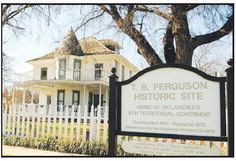
The air conditioner went out this week at the museum. On the days when the wind blew, we could open the front and back door and get a breeze. We had a visitor from the state of Washington. She grew up around Hitchcock and reads the newspaper feature each week so she wanted to come see the museum while she was in this area. We’re glad she did.
One of the names in the notebook that Frank Beneda did interviewing older citizens in Blaine County is Mr. A.R. Cook. He said his mother was trying to raise three children in northern Kansas. His father had deserted her and went back to Iowa. When times got really rough in Kansas she decided to come to Oklahoma Territory. She sold most of their possessions before making the trip. He mentions not having toys as a child they just made their own with sticks or rocks and such. They lived in a dugout close to Bond. Bond was a post office run by a Mr. Timbleton, with his son living on the next quarter and the son running a store. After the railroad came, the post office was abandoned. Bond was somewhere between Canton andLongdale. Theoutlaws, Yeager and Black, hung around that area. Black was shot a mile north of Longdale. Black was from northwest of Fairview. At the time Longdale had a young doctor named Eddington. According to Mr. Cook, Dr. Eddington didn’t stay around Longdale long but moved on to Watonga, “best he could remember”. He talks about the country school being only three months a year. He says they had to forge the river to get to town when he was little. You took off in the direction you needed to go because they weren’t any roads. Mr. Cook said Longdale made it on the map as the moonshine capital of the world. He said they never dabbled in it. He said people would haul it off in their cars and it was shipped on the trains sometimes to Kansas City. There was an old man from Kentucky that started it and taught others. That Kentuckian could also make the best wine ever. He spent a little time in jail for his moonshine. The law never found his still but found enough liquor scattered around to give him time. He said Blaine County and the Federal law came to get him. He said they went around with long poles sticking it in the ground and bushes. They wouldn’t have caught him except his wife had a bottle stuck around so she could find it while she was working. He said the hogs and mud turtles would get drunk from eating the mash left after a still was moved. Mr. Cook showed Mr. Beneda a picture of an old combine and described how it worked. It was pulled by four to six horses. He talked about shucking grain with a binder also pulled by horses. During harvest they averaged maybe 13 acres a day. They would stop and let the horses rest during the day. They would take their cattle and wheat to Homestead to sale before the railroad came to Longdale.
I’m not writing about Mrs. Ferguson’s book this week since this interview was so long.
Anyone that wants to volunteer or become a member of Friends of Ferguson Home is welcome. We welcome all the help we can get.