
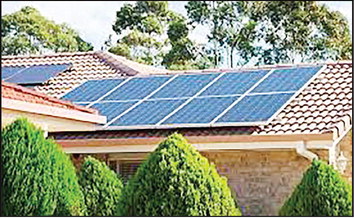
Watonga City Council has walked back its policy on behind the meter power generation.
Previously, the city strictly limited the amount of electricity it would buy back from a household or business that generated the power from wind or solar means. That limit was based on 1 percent of the city’s peak usage, or about 83 kilowatt hours, according to Jon VanSant of Oklahoma Municipal Power Authority, the entity from which the city purchases its electricity.
That limit was set a few years back, and was purposefully set low because OMPA uses its electricity sales contracts with cities as collateral for bond sales.
The new amendment is based on the city’s total energy needs, about 35 million kilowatt hours. The new amendment allows the city to buy back 1 percent, or 35,000 Kilowatt hours from its customers.
VanSant did say, though, the organization suggests size limits on solar installations, set at the customers’ peak usage. That pencils out to between 4,000 and 10,000 kilowatt hours annually.
Further, the customers with production capabilities will follow a metered-in, metered-out scenario. All electricity the household or business draws from the city will be metered and charged at the retail rate, while surplus the same household or business sends to the city will be purchased at wholesale rates, about 4 cent per kilowatt hour.
The difference, according to Mayor Bill Seitter, will help cover the costs of running electrical lines, maintaining those lines and other costs of electrical service distributed on all customers of the city’s utilities.
The council also heard a presentation from Garver Engineering’s Cole Niblett on the upcoming work on the existing sewage treatment plant. The plant has been at capacity for quite a while, but the so-called drying racks were taking their own sweet time in shipment. Basically, what Niblett has explained, is that the left behind sludge from the plant will enter the new racks, where it will be dried out and treated. It can then be placed in landfills, where as before the wet sludge had to be spread on an approved site. The city has a property it has used for this purpose, but the process has fallen out of favor with the department of Environmental Quality.
Niblett told the council that next time he came to them, they could expect a project that was ready for bids, probably around the end of March. Engineering for the project is going to cost some $970,000, while the entire project is expected to come in at about $7 million. This is apart from the recently- approved expansion of the sewage plant and a water treatment plant. Those projects are still in early the planning stages.