
Remembering Coot Nelson
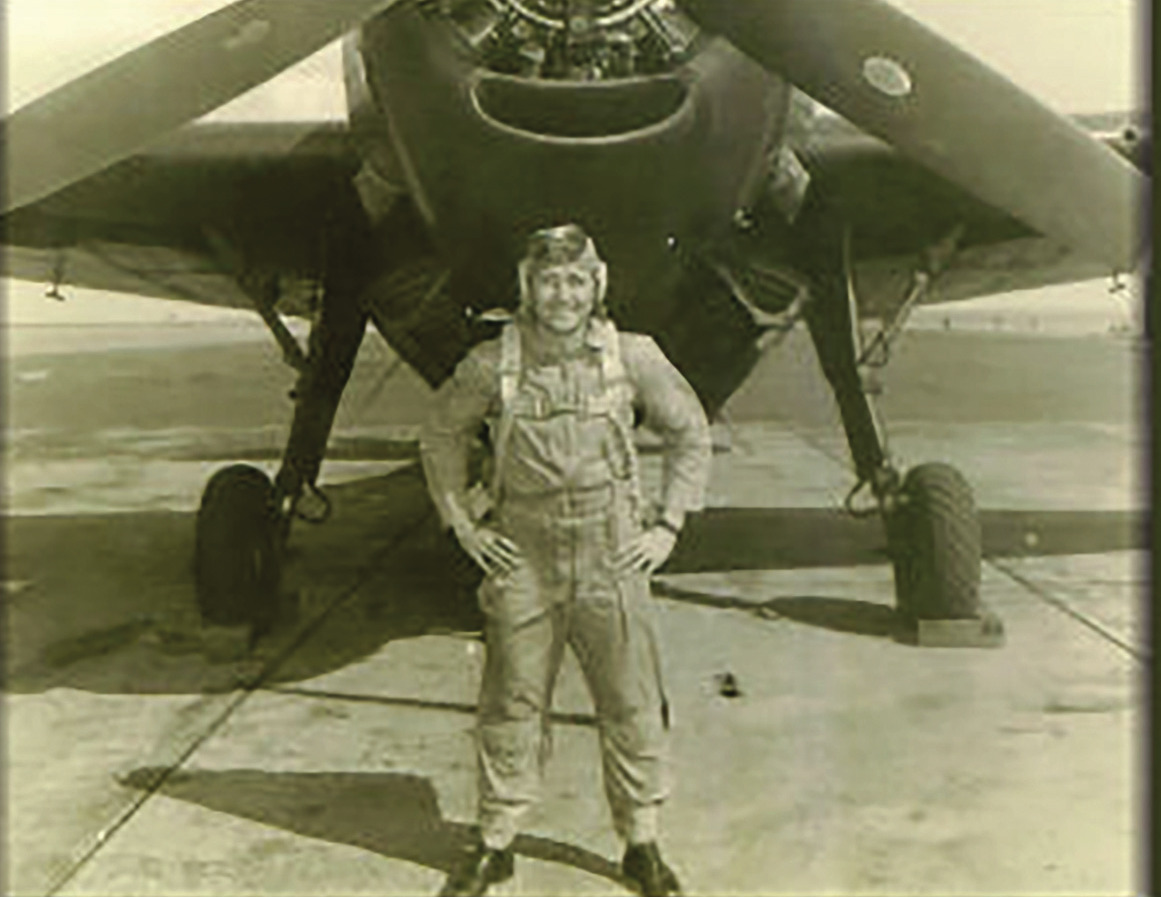

Extraordinary might be a word to describe the life Coot Harold Nelson lived, except it does little to capture the incredible events that shaped the life of one of Watonga’s most beloved citizens.
He had been born in Marshall County near Madill on May 28, 1918. He was a posthumous baby; his father died from the Spanish Flu a few months before he was born.
His mother later remarried, and the blended family boasted 15 children. There was never a time he didn’t remember working on the farm. In those days, everything was done by hand and horsepower meant harnessing and driving work horses. That posed a problem in getting to school and home again in time for chores because the horses were work animals, not saddle horses. To get around that problem, when he was in high school, Coot delivered ice and worked in a restaurant in Geary to earn his room and board so that he could go to school without having to find a way back and forth to the family farm near Greenfield. His home at that time was a 10x10 wash house at the restaurant.
Because he wrestled at Geary High School, Coot earned a scholarship to SWOSU in Weatherford. Taking mathematics and shop/woodworks, Coot received his teacher’s degree and headed straight for the Navy; his draft notice arrived the day he graduated.
“I went into the Navy flight training program,” he told the newspaper in Crested Butte, Colo. during an interview. His family maintains a cabin there to this day.
He started in the Navy one week and one day before Pearl Harbor was bombed on Dec. 7, 1941. “I got my wings after I transferred to the Marines, August 1942,” he recounted.
Nelson had taken some flight training at SWOSU, but had no idea where Pearl Harbor was.
“When we heard about the attack, we were all anxious to get into action. I became a flying cadet on Feb. 5, 1942 and I was dive bombing Japanese shipping on Feb. 6, 1943.That was one year and one day of training,”
COOT Page A 14 was 42 hours. More than half that training was in the obsolete biplanes.
By contrast, today’s Navy pilots train for 160 hours in instruction and another 96 hours minimum in new, state-of-the art flight simulators before they have completed the 21 stages of training.
Once, during a night training, he was supposed to meet up with his instructor at 1,500 feet. His plane had other ideas, cutting out at 700 feet. The flight tower didn’t answer.
He returned to the airfield, where there was no room on the runway to land because planes were taking off. Nelson set his plane down on a grassy strip where it ran off into a wet chuck hole, nosed down and broke apart.
The good times kept on coming.
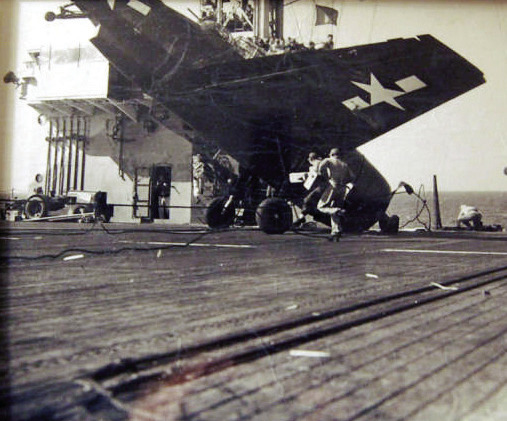
His first landing on a carrier was almost his last. It was a jeep transport, and to Nelson, it looked mighty small.
“ I had no qualms about landing on a carrier. What they said to do, we did,” he said. “(But) being a country boy and all, the carrier looked awfully small, more like a postage stamp!”
Nelson was in the first squadron of planes to leave the carrier, and his was the first plane to return.
But the signal officer was as green as the rest of the crew. He brought Nelson in too high. The tailhook on the back of his plane missed the grab cable. Luckily there were nets and barriers on the lip of the landing deck, which caught the plane and set it up on its nose, but stopped it before it went off the edge and into the ocean.
In spite of the close call, the fly boys were back at it the next day. “We broke the Navy’s record by making 602 carrier take-offs and landings,” he recounted.
602 take-offs and landings. On a carrier. In a single day.
There were other near disasters, too.
Another time, his plane engine cut out shortly after delivering its bomb payload. Nelson switched to the booster pump and stayed airborne. However, the fumes were so intense in the plane the two occupants – pilot and gunner – had to hang out the windows to get fresh air.
Nelson was able to get to a nearby landing strip, but not his own. He buzzed the strip, at the Marine's Air Base at Vella LaVella. They were trying to land other planes, but cleared the runway for Nelson’s Douglass Dauntless.
Once landed, the problem turned out to be a bit of Japanese shrapnel that had perforated the fuel line and lodged there. If it had severed the line, or if it had fallen out of place, the plane would have crashed immediately. As it was, Nelson, with the help of some Marines on the ground, replaced the line and took to the air again.
He laughed about it later. “I don't know how close I came to getting them, but I know how close they came to getting me!” That was October 1943. He was part of the air defense that dive bombed the Japanese supply lines until November 1943.
His squadron was then sent stateside and trained for carrier service. Coot left the Marines when the war ended.
But there was a battle he did not win, a battle of hearts. He met and married Bette Dietrich in 1943 after a very brief courtship. They teased that their marriage was temporary, for 62 years.
He went to Los Angles where he attended optometry school and graduated in 1947. He was a fixture in Watonga, practicing optometry for 37 years. Son Tim Nelson has kept the office going, and between the two Drs. Nelson, they have kept the town seeing straight for more than 70 years.
He was a board member of the United Methodist Church, Kiwanis Club, where he was a member for 37 with perfect attendance, Chamber of Commerce and the Watonga School Board.
In the recounting and retelling of these stories, it should not be lost that all over the nation, the same thing was happening. Farm boys were going to places they had never heard of, completing acts of heroism that have never been acknowledged or required in any other conflict. With little or no training, these warriors held the line between freedom and imperialism. As Dr. Tim Nelson said, “They stepped up and took care of business.” They could not afford to lose. It was not an option and the patriotism and selflessness they displayed must never be forgotten. There was only one ‘greatest generation’, only one Coot Nelson, and we will never see their likes again.
Information for this article has been gleaned from the July 3, 2013 Crested Butte News, Watonga.com, family lore and the Wilkinson Mortuary obituary for Nelson.