
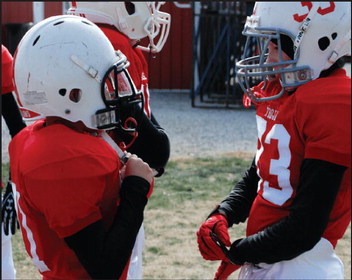
Football. Mention of the word elicits various responses. To many people, it is the most popular high school sport and has been the focus of Friday nights in the fall throughout their lives. To some individuals, it occupies every Sunday, Monday night and Thursday night in the fall as they follow their favorite professional teams. And to others, it is a sport with concerns about risk of injury.
Despite a drop of 20,565 participants in 11-player football from 2016 to 2017, there are more than one million (1,036,842) boys playing football. It is the No. 1 participation sport for boys by a wide margin. Although some of the decrease may be the result of concern regarding concussions, there are other factors as well. In some cases, a decline in enrollment has caused schools to discontinue 11-player football and start 8- or 9-player football, and in other cases, students may be electing to compete in other sports.
If attendance at some recent state football championships is any indication, interest in watching high school football and supporting the local team remains strong. In Texas, 48,421 fans attended the Class 6A-Division II final at AT&T Stadium in Arlington, and more than 228,000 attended the 12 Texas University Interscholastic League state title games, an average of 19,000 a game. And in Alabama, the seven “Super 7” state championships games totaled 51,651 – up 30 percent from last year. In Ohio, the seven state championship games totaled 52,390 – an average of 7,480 – and in 2017 in Kentucky, an alltime record of 52,796 fans attended the six state title games in Lexington.
As has always been the case, weather and location of the schools involved in the games affects attendance; however, these were good reports during a time when the future of the sport is being questioned by some.
In the end, whether it is a parent of a youth or high school football player, leaders of the sport at all levels, insurance companies or the participants themselves, the question is the same: What is the risk associated with playing the sport? And with regard to the answer to that question at the high school level of football, we would say that the risk of injury is less today than at any point in the history of the sport.
The NFHS has been writing and publishing its own rules in football since 1932, and the organization has had an unwavering focus on risk minimization. However, by the late 1960s and early 1970s, the number of deaths in high school football had accelerated, with a high of 35 in 1970. In 1975, spearing was outlawed and several other equipment and safety- related changes were put in place and the number of fatalities dropped significantly.
In 2016 and 2017, there were only two direct deaths each year compared to an average of 20 annually in the late 1960s and early 1970s. Moreover, as opposed to 50 years ago, today playing rules are in place at the high school level to manage a student who exhibits signs and symptoms of a concussion. Thanks to these guidelines and state laws in place, the incidence of high school players incurring a repeat concussion has been greatly reduced. In addition, practice restrictions and contact limits have been adopted by all member state associations.