
OKLAHOMA CITY — Due to pesticide use, habitat loss and climate change, Oklahoma’s native insect and bird populations have been rapidly declining. To address this issue, the Oklahoma Association of Conservation District’s Yard by Yard program and Oklahoma Monarch Society’s Okies for Monarchs program launched a first-of-itskind Wildlife Habitat Grant program. Funding for this program was generously provided by the Kirkpatrick Foundation, whose support made this new conservation effort possible.
The demand for native habitat projects is clear: the grant program received 216 applications spanning residential, commercial, public, and farm sites. In the end, 33 projects were funded, resulting in the creation of 761,905 square feet of new habitat and the planting of 3,809 native plants across residential yards, farms, apartment courtyards, and one welcoming public park.
Each grantee received $525 per 100 square feet to install between 100 and 1,000 square feet of habitat. Funded projects followed clear ecological guidelines, including: No use of chemical herbicides, pesticides, or fungicides; One native plant for every two square feet; At least three blooming wildflowers for each growing season, spring, summer, and fall; A minimum of three native pollinator host plants; One native woody species per project Participants also received technical support, design resources, plant selections, and a list of native plant nurseries and landscapers.
If You Build It, They Will Come “At our farm, we choose to garden with native plants because we try to live and work with nature—not fight against it,” they shared. “As we’ve added native plants to our farm, we’ve seen an increase in native critters of all sorts—mammals, insects, birds, reptiles, and amphibians. Native plants increase our sense of wonder and connection to the land.” said Amy Brock and Crysta Haskins of Sun Buckle Farm in Lexington.
Toads, frogs, hummingbirds, moths, wasps, dragonflies, butterflies, bees, and even a bird called the Eastern Phoebe have all found their way to the farm — with the Eastern Phoebe frequently using a cedar post as its favorite hunting perch. “We can’t wait to see what shows up during the Monarch migration!” they added.
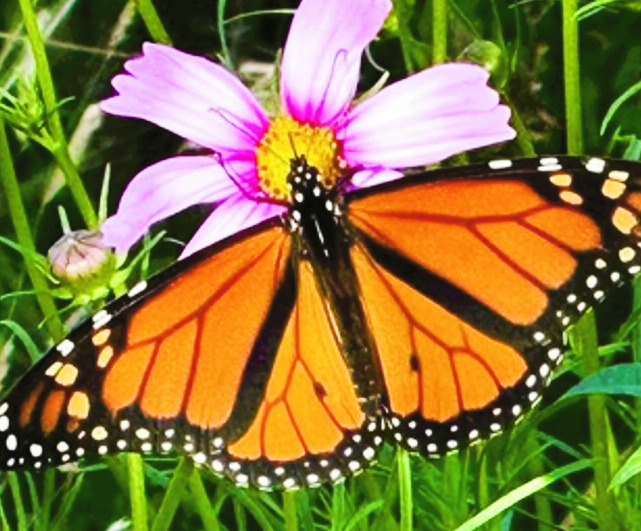
Over in Calumet, at Pugh Gardens, owners Daniel and Ruthie Pugh witnessed a similarly vibrant transformation just one month after completing their project. Several butterfly species—Monarch, Queen, Gulf Fritillary, Cloudless Sulphur, Red Admiral, and more— quickly began visiting. Dragonflies now abound, hummingbirds feed on newly planted sages and blooms, and tiny skinks scurry among the plantings, adding a sense of wonder to the vibrant habitat.
Creating Habitat and Community But the impact wasn’t just ecological—it was social. In Mustang, Kassidi and Omar Zarate said the project quickly sparked neighborhood interest.
“We’ve had multiple neighbors stop by to discuss the project since the first few days we started,” they shared. “Everyone showed excitement and enthusiasm for what was to come. This led to discussions about pollinators and the initiatives we were taking—with genuine interest. Since completion, it’s been an outpouring of praise and adoration.”
Grants in the Ground The 33 funded projects were spread across Norman, Yukon, Edmond, Nichols Hills, The Village, Forest Park, Mustang, Lexington, Calumet and Oklahoma City.