
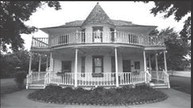
Electric power rates and types of production (gas fired steam turbines vs wind turbines and solar) have been on the minds of citizens of Watonga recently. At the Ferguson Home Museum, I have been wondering if electricity was installed when the Victorian Style home was built in 1901, or later. An article in the Encyclopedia of Oklahoma History and Culture by Terri Crawford indicates that by statehood, or at least 1910, “Electric light service and city water system operated.” OK History Mrs. Ferguson writes in her book “They Carried the Torch: The Story of Oklahoma’s Pioneer Newspapers” (perhaps concerning 1900) “An electric light plant was being promoted, so we had visions of the not far distant future when coal oil lamps could be discarded.”
None the less, the electrical outlets in the Ferguson appear quite rudimentary and sparse, and I am certain it would be easy to overload the circuitry.
However, for many in rural Blaine County, the opportunity to read the Watonga Republican by electric light was not to be realized by most until 1937 when the Cimarron Electric Cooperative established power to much of Blaine County. Before that, electricity could be generated by a ‘wind charger’ which would charge batteries to run lights, a radio and small appliances.
A few had a Delco System consisting of a gasoline engine that ran a generator that charged batteries. A car or truck electrical system could be channeled to batteries or directly into a wired home, but few had a truck or car in the Depression. In Oklahoma in 1920 approximately 4 percent of rural homes had electricity. Nationally, by 1934 an estimated 11 percent of American farms had access to electric power, but Oklahoma lagged behind. OK History Rural Electricity.
However, in 1936, Franklin D. Roosevelt created Executive Order 7037 (under the Emergency Relief Appropriation Act of 1935) established the Rural Electrification Administration (REA) on May 11, 1935. In May 1936 the president signed the Rural Electrification Act, passed by Congress earlier that year.
Under this legislation rural electric cooperatives of farmers could be developed and could apply for loans from the REA. Farmers could apply for private wiring/electrification loans for homes/barns at 6% interest.
Under the 1936 legislation the first loan to a member-owned co-op came on October 1, 1936, to the Cimarron Electric Cooperative of Kingfisher. The Kingfisher-based organization completed construction of a plant and lines, and on December 24, 1937, became the first of its cohort to turn on the power.
Thank you again, Cimarron Electric Cooperative, for the generous donation to the Friends of the Ferguson Home.