
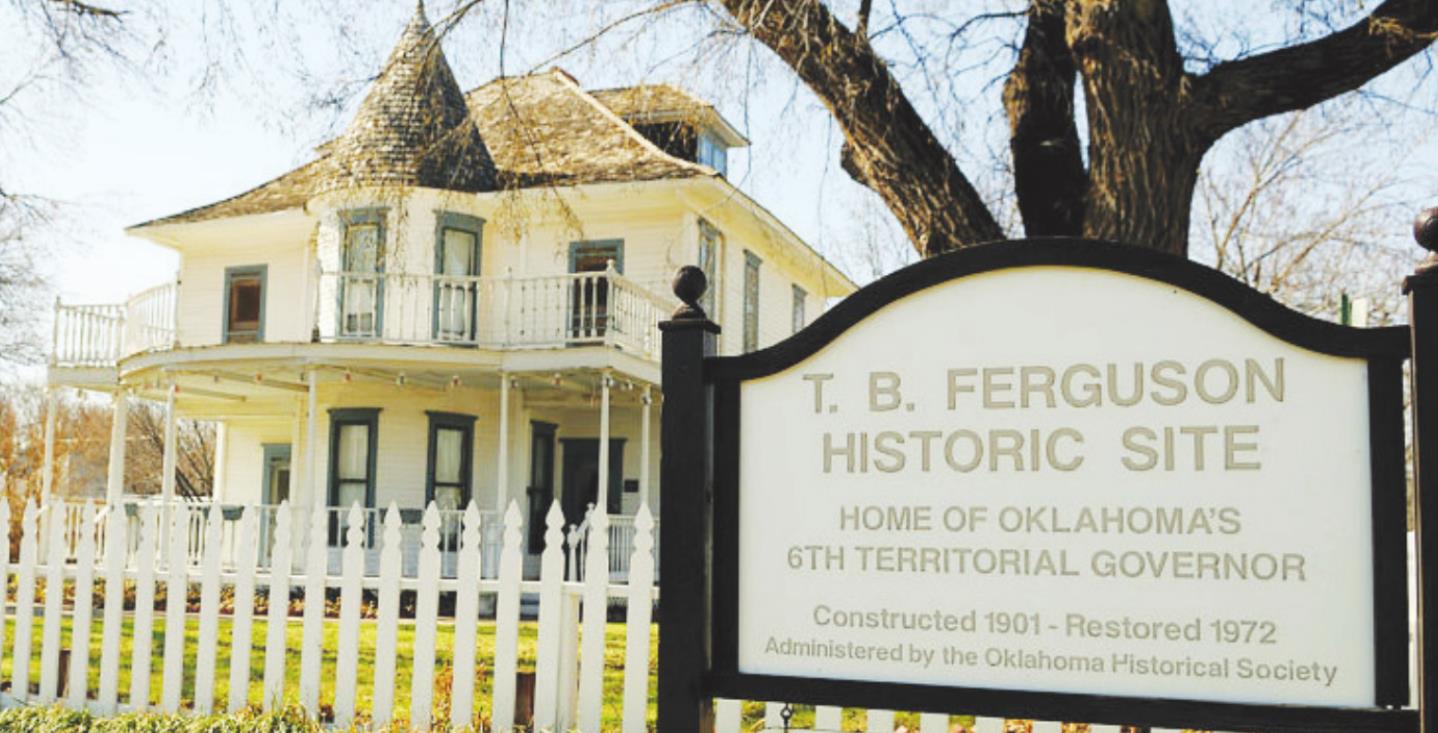
It’s been a quiet week at the museum with just a few visitors. Barbara said a couple of people said they would come back when they had more time so they could look around in depth.
Clay was out Wednesday doing more work on the front porch. He and Anthony were out Saturday scrapping and fixing the wood around the windows. He said hopefully in the next few weeks they should be able to put up the new columns.
I looked into the Hoosier cabinet we have in the kitchen and found some history of those cabinets and why they were named Hoosier. A Hoosier cabinet gets its name because most were manufactured in Indiana. The first Hoosier cabinets gained popularity in 1898 and they stuck around until the 1940s. Until the 1920s, it was rare to see a house with built-in kitchen cabinets. If you were purchasing a home, it very seldom featured storage space in the kitchen area. The largest manufacturers included The Hoosier Manufacturing Company, G.I. Sellers and Sons, McDougall Company, Coppes Brothers and Zook, and Campbell-Smith-Richie. They have deep lower cabinets for large pots and pans. The workspace countertop is typically made of porcelain. The upper cabinets are shallower. They are typically made of wood. Those made before 1920 are oak, but some are walnut, white maple, or pine. Any drawers you find should be lined with tin. They were meant to keep bread fresh for longer, and there should be at least one drawer somewhere under the workspace that is lined this way. Ours isn’t an original Hoosier cabinet. It is a kitchen cabinet that was probably used in that time period. They would have cost around $20.00. I looked for a tag with the manufacturer’s name but couldn’t find it on the part we can see. It could be on the back or the other end next to the wall. Ours doesn’t have a porcelain countertop or the tin lined drawer. Ours is still very sturdy and the drawers are still intact. I never gave it a thought that kitchens didn’t have cabinets until in the 1920’s before reading this. Though I do remember my grandmother’s kitchen just having a dry sink and wood burning stove.
In territorial days when a governor became unpopular he was not impeached, but charges were filed against him, with the Secretary of the Interior. The final decision of his guilt or innocence rested with the President. With the death of President McKinley, Governor Jenkins lost his best friend at the nation’s capital. One of the early transactions of the Roosevelt administration had been to remove Jenkins from office. President Teddy Roosevelt called a delegation of Oklahoma citizens to the White House in consultation concerning the appointment of a new governor. After several names had been proposed and rejected, Roosevelt asked if there was not one honest man in the whole territory upon whom he could depend and who had the nerve and backbone necessary to make a success of the job. One of those present suggested that a redheaded editor in western Oklahoma was that sort of man, Thompson B. Ferguson.
We have had a lady offer to come and create a digital inventory of the artifacts; thank you Shirley. We need someone to clean out the flower beds. If anyone is interested just let us know. If more than one is interested it would go much quicker, or just work an hour or so at a time, we wouldn’t expect you to work until you drop. The city mows the yard as part of the parks department but those guys don’t have time to clean the flower beds.
The next Ferguson Market will be this coming up Saturday, August 7, 8:00 am to 12:00 pm. I’ve had a couple of different people say they think the market is a good idea. Call 580-623-5069 for more information or to reserve a spot. Be sure and leave name and call back number if you get the answering machine because we don’t have caller ID.
Our hours are Wednesday thru Saturday, 10:00 am to 3:00 pm. We welcome volunteers in any capacity and anyone wanting to become a member of the Friends of the Ferguson Home Museum.