
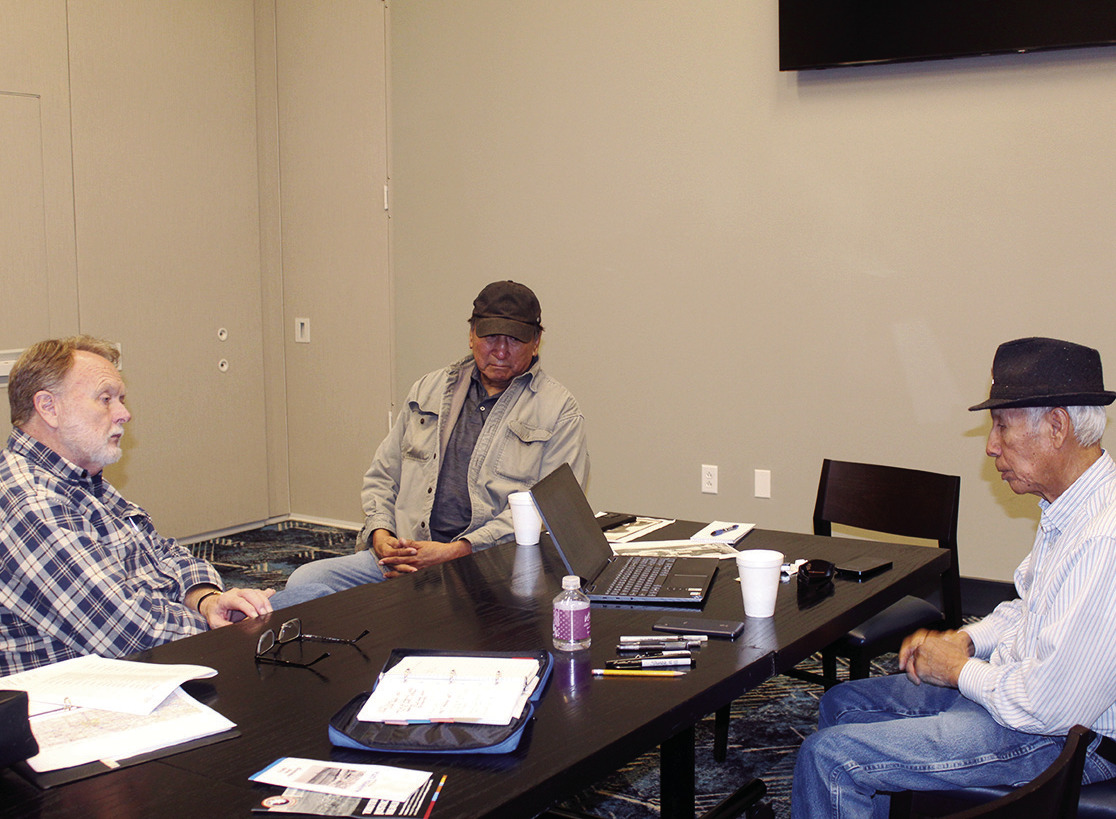
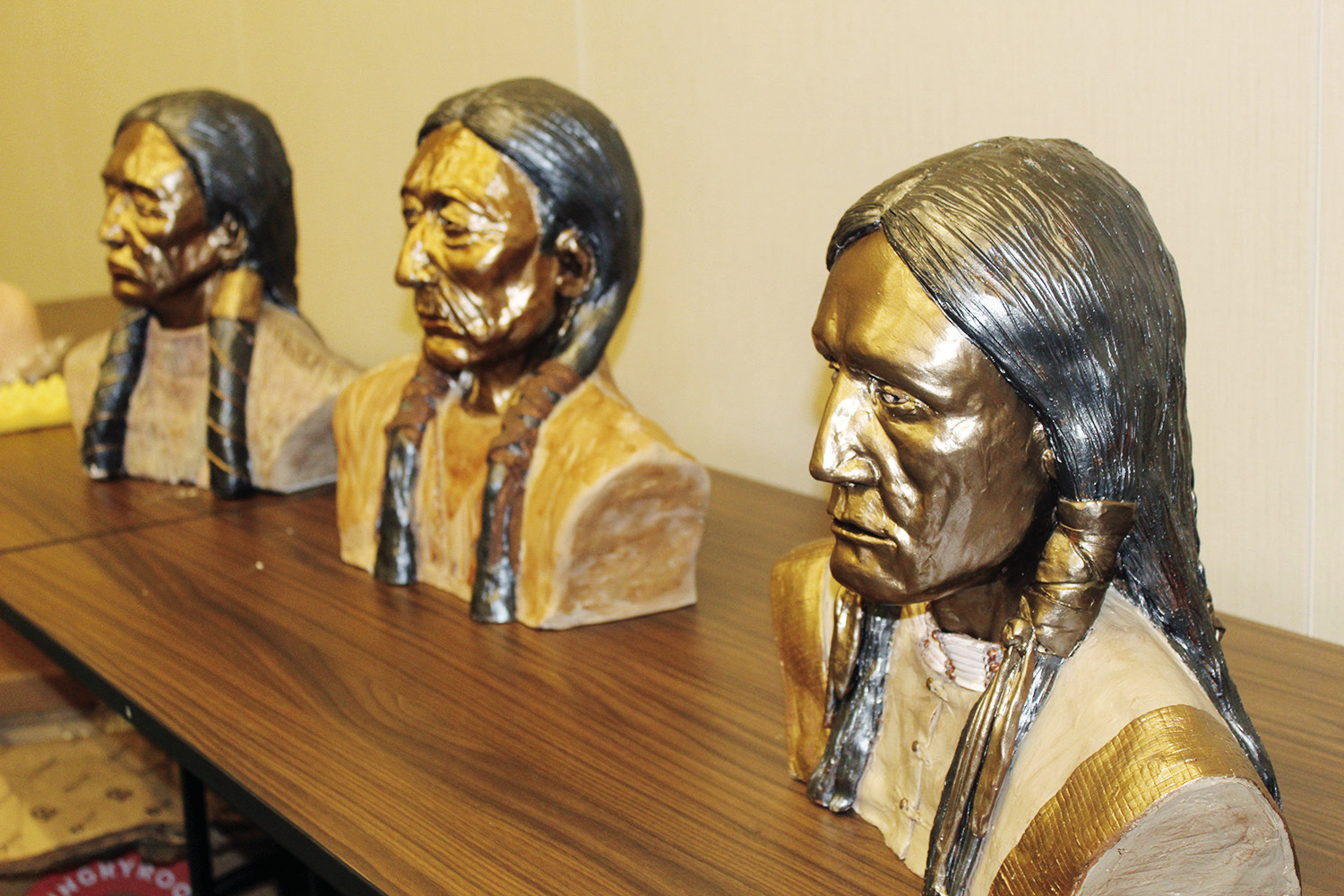
Lew Aytes, a sculptor and artist from California, met Friday in Watonga with the closest living descendants of Chief Henry Roman Nose. Aytes had come to gain the blessing of the Roman Nose men – Larry, Quinton and Melvin – for a proposed sculptured bust of their famous ancestor.
Henry Roman Nose was one of many tribal leaders from this region who were rounded up, arrested and labeled as ringleaders and troublemakers when the land was opened up to white settlers. They were sent to prison about 1870 in Saint Augustine, Fla., to Fort Marion, also known as the Castillio de San Marcos.
On arrival, the men had clay masks made of their faces. There was no consent, much less informed consent, according to Aytes. The original masks were copied into three sets of duplicate casts. One is housed at the Smithsonian Institution. There are only four of the original masks remaining, the others lost through breakage, ill storage or just lost.
Aytes has chosen 15 faces to sculpt, representing five tribes, including the Caddo, Arapaho and Cheyenne.
He isn’t the first artist to attempt to use the casts as the basis of sculptures, but he is thus far the only one to gain permission from the Smithsonian. That is, he said, because he is working with the families of the imprisoned leaders first to make sure they grant permission and to ensure the art is representative of the man. Aytes said he wants to tell the story of the men as artists.
There were ledger artists and painters, tinsmiths and other art forms represented among the 72 captives. They were encouraged to make art to sell to pay for their food while in the fort and to send back to their families.
Henry Roman Nose was known for his work on teepee covers and as a tinsmith. Larry Roman Nose, Henry’s grandson, said there are examples of his work at Bent’s Fort in Colorado.
Aytes has completed several sculptures thus far, including Medicine Water, Makes Medicine and Okahater. Okahater is buried at Watonga and is known as the first Native missionary. He was also known as David Pendleton.
While Aytes was in Watonga with the Roman Nose clan, they went over notes and compared multiple photos and documents. One likeness that was reported to be of Henry Roman Nose was rejected in part because they couldn’t be sure it was him and if it was him, the likeness wasn’t very good.
“You go straight to the tribal members,” said Melvin Roman Nose. “That’s what I like.”
After several hours, selections of the clay cast and photos to use for the sculpture were finalized. They also discussed the sticky business of repatriation of Native artifacts and remains. The 1990 Graves and Repatriation Act holds museums responsible for returning identifiable items to the appropriate tribe or family. The difficulty comes, Aytes said, when finding those persons is next to impossible. Then the family or tribe must find a way to carefully conserve what might well be a priceless artifact, the only one of its kind known. They can’t just be stored in a box in the garage.
In 2022, the Smithsonian instituted a new rule that not only its 27 branch museums follow the 1990 act, but also its 200 partner museums must participate in ethical returns of items.
Larry Roman Nose has attended the repatriation of remains of Cheyenne and Arapaho tribal members. There is, he said, an entire protocol in place for the respectful reinterment of the remains. “That way the ancestor can be at peace,” he said.
Aytes, for his part, is working closely with the museum and the families so the sculptures of the captives are done with sensitivity. The casts, most of which were made before the captives had their hair cut off, resemble more death masks than that made of a living human being.
“I want to recreate the faces with their eyes open and return that likeness to the family,” he said.
The C&A tribe has been working on cleaning and improving the Watonga Indian Cemetery and properly marking the gravesites. There has also been talk of a monument, museum and veteran’s cemetery at the site. Aytes was very interested in the project.
“Would you like a standing (sculptured) Henry Roman Nose for the cemetery?” he asked the descendants. They responded yes, absolutely. Immediately, Melvin launched into the records and photographs on hand to find an appropriate likeness. He is hopeful the life-sized work will show Henry Roman Nose in full regalia, including headdress, returned to land his family knew for centuries.