
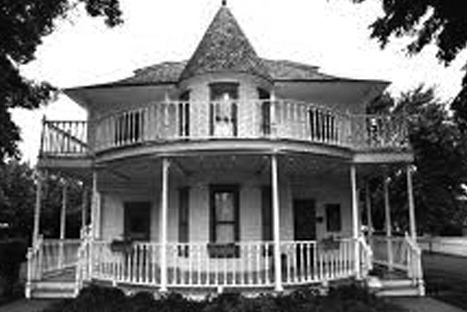
Edna Ferber recognized the Fergusons’ story as so remarkable as to write a book about the family that participated in the 1889 and 1893 land runs and settled in Watonga after the 1892 run. Ferber visited the Ferguson home in 1927 or 1928 and began writing the epic tale of “Cimarron.”
In 1930, RKO studios put on film the great story of early Oklahoma that loosely followed the lives of the Fergusons. Mrs. Ferguson consulted on the early printing office for the film patterned after the Watonga Republican which they began. The land run scene involved about 5,000 people, horses, wagons, bicycles and cannon and depicted people from all over the world trying to claim 160 acres of free land, or a lot in planned towns like Watonga. This production won three academy awards in 1931 including best picture Cimarron 1931 Less known is the remake of ‘Cimarron’ in 1960. In 1941, MGM bought the remake rights to ‘Cimarron’ from RKO for $100,000. In 1947, MGM announced an operetta version, but this did not happen. In1958, MGM announced plans to produce ‘Cimarron’ as the studio’s second film using the MGM Camera 65 process. Elizabeth Taylor and Rock Hudson were considered to star in the film, but ultimately, Glenn Ford (Yancey Cravat), Maria Schell (Sabra), Anne Baxter (Dixie Lee) and Harry ‘Henry’ Morgan (Jesse Rickey) starred. Arnold Schulman wrote the screenplay and introduced several characters and removed Cravat’s daughter, Donna, and the boy Isaiah.
The director, Anthony Mann explained he wanted to show how the diversity of mankind tore out across the plains and set their stakes as claim for the land, how a town, a city and finally a metropolis grew.
The film production began on-location in Arizona and experienced dust storms, so the producer Edmund Grainger relocated the production on the studio backlot despite Mann’s insistence to film entirely on location. However, the Oklahoma Land Rush, which featured a 1,000 extras, 700 horses and 500 wagons and buggies, was shot on location in Arizona. Mann left the production and director Charles Walters finished the film but received no screen credit.
Mann was critical of the final version as was Edna Ferber. ‘Cimarron’ earned $2,325,000 in the U.S. and Canada and $2,500,000 overseas, resulting in an overall loss of $3,618,000. The film was 2.5 hours in length, and the best part, according to critics, was the land run scene at the beginning Cimarron 1960. Just imagine that the Fergusons and Watonga inspired two Hollywood films, and continue to inspire visitors and citizens today.