
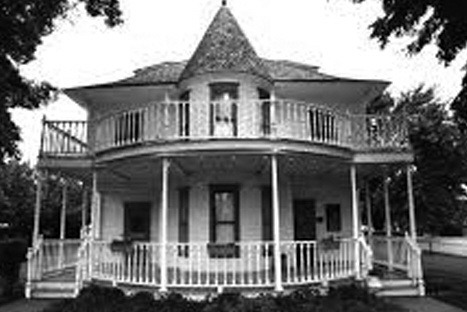
The Wild West is romanticized even to this day through books, movies and even some historical recreation towns. This fascination has brought many to explore the Fergusons’ lives as well as the Ferguson Home. The Fergusons themselves have fed into this romanticized idea through Elva Ferguson as she was an inspiration for the western book Cimarron by Edna Ferber. It was later adapted to movies twice. The greatest fascination for this time period is predominantly the saloons and outlaws. As a matter of fact, there is a segment in the Ferguson Home tour when I talk about the conflicts that arose for the Fergusons with outlaws and saloons. T.B. Ferguson was a prohibitionist and would often speak negatively against the seven saloons in town. This would be met with steel and fire from both outlaws and saloon owners. It's usually when I get to the red window on the first floor and speak of its significance that this story reveals itself.
While red windows during this time would have usually been for decoration, it wasn’t normal for families to have just one. It is also strange that the window doesn’t have any significant decorations, or additional colors. That is because this window served a different purpose altogether.
The actual purpose was for protection so that it was harder to see the lanterns at night. The bedrooms of the museum were on the upper floors, and the house did not have electricity when it was first built. This meant that a lone outlaw could gun the occupants down in the dead of night by aiming for the lantern light.
Why would they be worried about outlaws, you may ask? Well, T.B. Ferguson had declared war on saloons and lawlessness just a few months after starting his paper. His firm beliefs, with his background in ministry and education, helped him push his prohibitionist ideas, leading him to confrontation with both entities.
First the saloons struck by paying a boy $10 and a quart of whiskey to light the Watonga Republican on fire one winter while the Ferguson family lived in the rear of the building. The saloon owner was let off and never charged. Then one night in 1893, after a bit of drinking, outlaws fired three shots into the Watonga Republican offices. Both parties were determined to run off that “damned editor” as he was called in the book 'They Carried the Torch'. But that did not stop the Fergusons; in fact, Ferguson would call them out as cowards. One shot barely missed a member of his family.
Eventually, when their house was being constructed in 1901, the Fergusons decided to put in their red window. This was to ensure the outlaws and saloon owners would not have an easy target. Now in the present day, that window is a reflection of the ideals and risks that those ideas brought in a lawless time. But even with the danger they faced, the Fergusons persevered. His beliefs would gain ground in 1907 and prohibition would be written into the Oklahoma Constitution and last more than 50 years.
Hunter Martinez is the guest writer for this week’s Ferguson Features while the regular writer is otherwise occupied. He is also the weekend docent for the Ferguson Home Museum