
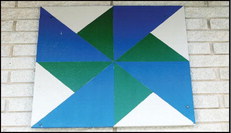
Barn quilts are a symbol of rural heritage and storytelling whose origins can be traced back nearly 300 years.
Often made of plywood or aluminum sheets, barn quilts are painted to represent quilting blocks used in fabric quilt making. The geometric designs can be a recreation of a single block on a family quilt, inspired by the surrounding land, or made to resemble traditional quiltblocking patterns.
Paint was expensive in the 1700s when immigrants from central Europe arrived in the colonies, and barn quilts served as a cost-efficient way for settlers to decorate their new homesteads.
Their popularity grew throughout New England and the Midwest until paid advertisements for products and local businesses began replacing them in the 1900s.
In 2001, Donna Sue Groves painted and hung a barn quilt to honor her mother - and her neighbors in Adams County, Ohio, took notice. Groves collaborated with the Ohio Arts Council to install an additional 20 barn quilts in the surrounding area.
Since then, barn quilt trails have been popping up in rural communities across the country, including in Oklahoma.
Today, barn quilts serve as a nostalgic reminder of an earlier era and as a grassroots effort for rural revitalization.
To learn more about barn quilts and the Oklahoma Quilt Trail, visit OSU.EDU