
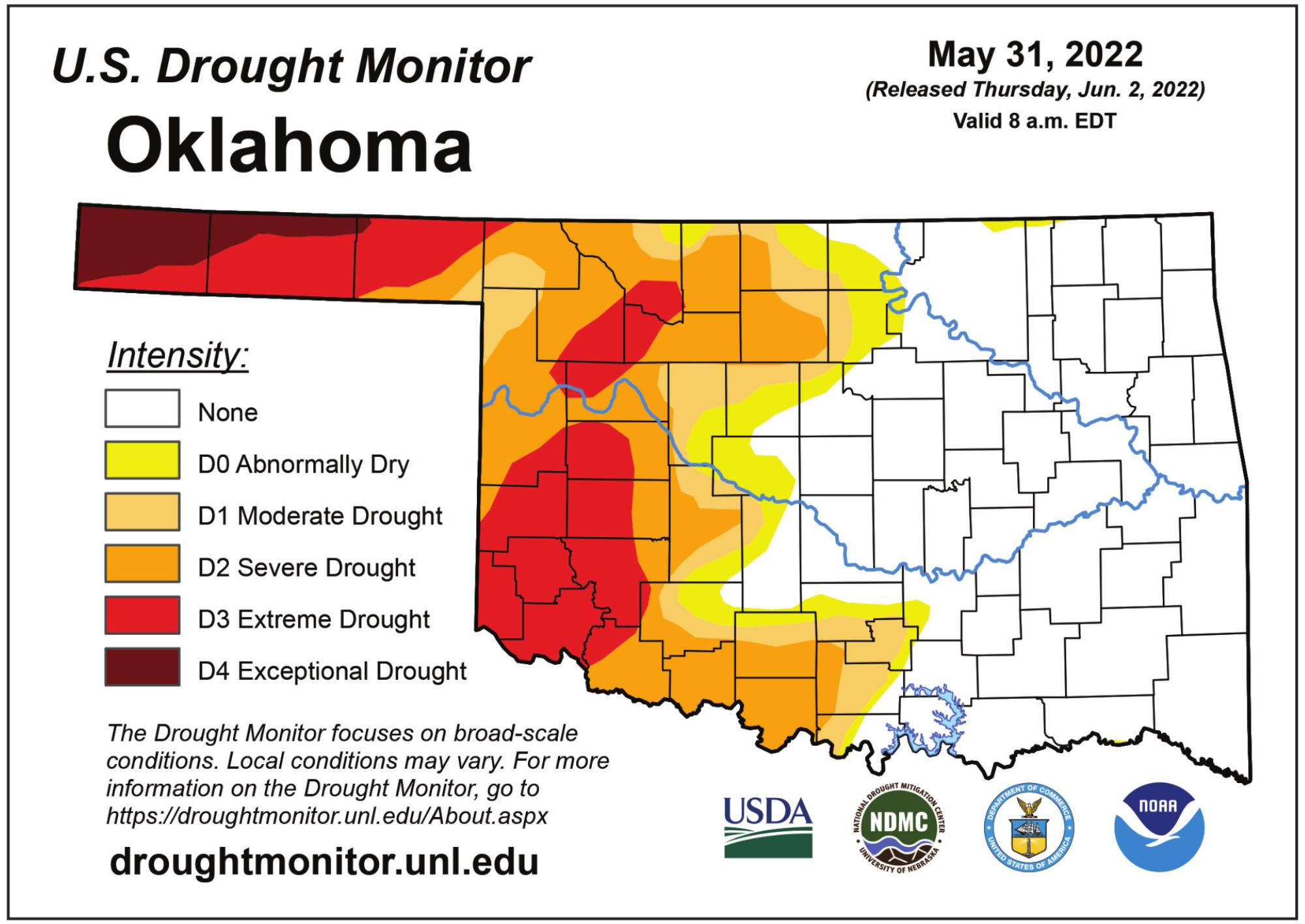
WATONGA – Recent storms and showers have significantly eased western Oklahoma’s drought conditions, ending an abnormally dry spring and bringing much-needed moisture to the region.
Watonga has received more than 6.5 inches of rain in the past two weeks, estimates show, and about 7.5 inches in the past month. Blaine County is still technically experiencing drought conditions, according to the U.S. Drought Monitor, but the storms have lessened the drought’s severity rating across the entire county.
On May 17, all of Blaine County was considered to be in “extreme drought” conditions, which is the secondworst designation behind “exceptional drought.” But by the end of May, the southeastern portion of the county was merely “abnormally dry” – the least-severe drought designation – while most of the rest was experiencing “moderate drought,” two notches below the “extreme” level.
A new map to be released on Thursday may show the drought has further alleviated with additional rainfall in the past week.
Blaine County was among the rainiest regions of the state over the past two weeks, though other cities were even more inundated. Butler, a tiny town in western Custer County, has received almost 10.9 inches of rain over the past two weeks, as of June 6.
Stillwater received 9.12 inches, Weatherford received 8.55 inches, Oilton received 10.12 inches and Wynona received 8.56 inches in the past two weeks. There was no dry corner of the state, though totals were generally much lower in the southeast corner and the drought-stricken panhandle.
Boise City recorded only 1.18 inches of rain during the fortnight, while Eva got 1.26 inches and Beaver received 1.4
Ṫhe turnaround is an encouraging sign for the region, but drought can return quickly as Oklahoma moves away from its typical rainy season. After Wednesday storms, the forecast shows decreasing rain chances for the rest of the week and no shot this coming weekend, with high temperatures in the 80s and 90s.
The rain’s timing was inconvenient for local wheat farmers, who didn’t receive the precipitation necessary to maximize the crop but had to delay the start of harvest due to storms.
Despite the rains, a huge swath of southwestern Oklahoma is still in “extreme” drought, as of May 31, as are portions of Dewey, Woodward, Ellis, Major and Woods counties.
Most of the panhandle is still in “extreme” drought and its far northwestern regions, including most of Cimarron County, are in “exceptional” drought, the harshest designation.