
The first wagon train, with more than 500 people to leave Fort Smith, Arkansas, during the California Gold Rush in 1849 was led by Capt. Randolph B. Marcy and the Fifth Infantry. This party followed the southern route, known today as the California Wagon Road, which passed through the central parts of Oklahoma, through North Caddo County (Hinton and Hydro areas) then through the Texas Panhandle and on to Santa Fe, New Mexico, before continuing to California. This first wagon train passed through the Hinton and Hydro area on May 23, 1849, some 52 years before either town was established.
As the party traveled it was soon realized by the Infantry soldiers and other young men of the wagon train, that there was a beautiful and friendly 17-year-old girl traveling with her family among the party of emigrants. This girl was Mary Conway of Little Rock, Ark. and second cousin to former President James Madison. So, with her connections to the office of the United States President, her good looks, friendly manner and being unmarried at 17 (average marrying age for women in 1849 was 16 to 17 years old) any and all single men on the wagon train were soon becoming rivals in winning her over. Over the course of several weeks on the trail some of the men were coming up with very creative ways to outdo the others in winning Mary’s attention. But as this was happening Mary had begun setting her sights on a certain Fifth Infantry Lt. M.P. Harrison. (Grandson of the future U.S. President, Benjamin Harrison serving 1889 – 1892.)
Then, on the morning of May 23, after leaving their overnight camp of the previous night, which was recorded as camp number 33 for this party, located near where the old town of Niles, established some years later east of Hinton, Lt. Simpson, chief surveyor of the Infantry party, notices the grouping of mounds on the western horizon (west of where the town of Hinton sits today) and begins working a new strategy of his own to outdo any others in an attempt to also win young Mary’s attention. He, being the lead surveyor, knew their wagon train would reach these mounds before the end of the day and when the opportunity was right, he would make his move to name one of the mounds after her.
Once the wagon train reached the mounds Lt. Simpson took the first opportunity to run his horse to the first mound they came close to. It wasn’t the tallest or the most prominent looking mound of the group, but he couldn’t afford to take the chance that another soldier had thought of the same idea and could be waiting farther ahead already perched upon a taller mound. Once he reached the mound and worked his way to the top, others from the wagon train had also approached and began gathering around the bottom. It was at that moment, when Lt. Simpson raised a flag and paused for a moment, that Lt. Harrison, also at the bottom and presumably standing beside Mary, yelled up to Simpson and suggested he name the mound after Mary. Simpson followed suit and named the mound “Rock Mary” after the Arkansas girl, and at that moment Mary Conway and Lt. Harrison became engaged. Once the mound was named and the couple were engaged the wagon train traveled a few miles further and camped for the night. This camp became “camp number 34” for the expedition.
Knowing how wagon trains selected their camps and by reviewing the daily mileages recorded in Capt. Marcy’s and Lt. Simpson’s personal journals, (reproductions are housed in the Oklahoma History Center’s archives in Oklahoma City. The originals are preserved in the Library of Congress in Washington D.C.) it was not hard to locate the emigrant campsite. But because an early homestead had been built on the same site, which was bulldozed and buried there in the past, it was deemed to be too disturbed to do a beneficial excavation. Therefore, a smaller, off-the-beatentrail second choice campsite, likely never used more than once and lying a few hundred yards away, was selected as a possibly potential excavation project. Once permission was gained and the weather cooperated, this second-choice wagon campsite became my winter excavation project for the last three months of the 2022 winter season.
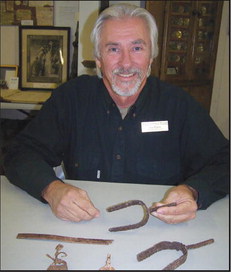
The first couple days of working the site were slim pickings and it begin to look as if this site would be another nonproductive and unimportant sight. But by the third day broken wagon parts, some hand forged items, and metal drippings known as slag from a blacksmith’s forge began to appear. Then somewhere around the fifth day and into the fourth week, hand cut shrapnel began to also appear. Shrapnel, being cannon ammunition and hand cut at that, told us we had definitely located the Fifth Infantry campsite who had recorded towing a cannon while escorting this first emigrant wagon train to California, and the same group that had earlier that day named the legendary Rock Mary Mound. By the time this campsite excavation was completed, some 93 artifacts were unearthed with 85 of them being of the correct 1849 time period.
Because of this site’s off-the-beaten-trail location, several hundred yards off the main wagon trail where wagon ruts are still visible today (from the ground as well as from the air) showing us exactly where the main trail passed, and with no other evidence of other wagon trains camping in this off-thebeaten- trail site, we can presume all 85 time period artifacts were from the one-night stay by the Fifth Infantry on the night of May 23, 1849. But then 85 items, which is a larger than average amount of artifacts, even for a well-used campsite over several years’ time period, are about twice as many than would be typically expected. This shows us, as was well documented by grid mapping the sight as our work progressed, that at least three activity areas, each containing a traveling forge which military troops always had on hand, were in full operation and obviously did a full day’s (evening’s) work to achieve the major wagon repairs necessary before leaving out the next morning, as the leading officer’s journals indicate they did.
In reviewing the list of artifacts pertaining to broken wagon parts, it becomes clear that the military wagon towing the cannon was the wagon that had an accident that same day leading to many of the front and rear axle under carriage bolts, brackets and hitching hardware pieces being broken and discarded within the camp. After being unearthed these artifacts are now preserved and on display at the Hinton Historical Museum.