
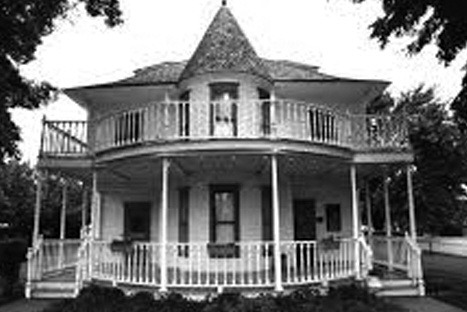
T.B. Ferguson was postmaster in Watonga 1897-1900. Elva Ferguson succeeded him and served for less than a year when Ferguson was appointed Governor of the Territory of Oklahoma. In the July 1, 1917, Watonga Republican, postal service in Watonga is summarized by Ellen Shaw in “This Old House…In Watonga.
“With the land run of April 1892, John Dillon came from Kingfisher to Watonga, a town of tents, with commission as postmaster in his pocket and the necessary supplies in a wagon. A tent housed the office until a wooden building could be erected.”
“Mr. Dillon had secured a lot by Keller Funeral Home (now Wilkinson) and soon had a building ready for it. The mailboxes and other equipment were very simple, and were made by a local carpenter. There were no lock boxes where patrons could get their own mail, only rows of pigeonholes, covered on the outside by screen wire, on each side of the general delivery window in order that patron could see whether the box contained mail, but must be handed through window. There was a large registered mail business, but no money orders until three years later.”
“The contract for carrying the mail was awarded to G.M. Woodworth, owner of a local livery stable. Kingfisher was the nearest railroad point, and the mail for Watonga was bought daily from the place by stagecoach. In order to make the round trip in one day, an extra team of horses was kept at Omega, the half-way station, and the horses changed on the way to and from Kingfisher. Passenger, express and articles of merchandise were also carried by the coach. It was usually dark before the mail arrived at the Watonga Post Office, and almost every citizen of the town was on hand to greet this, the only communication with the outside world. …In the fall of 1892, arrangements were made for an assistant in the office. The stagecoach and mail line continued until the railroad arrived in 1901 and took over the contract.”
Between 1900, when the Fergusons moved to Guthrie to serve as Territorial Governor, and construction of the present U.S. Post Office building constructed in 1937 and currently in use, there were many interesting improvements in mail service.