
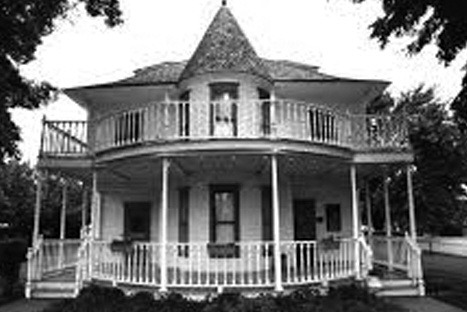
As we complete our celebration of May as National Preservation Month, we thank Dr. Kay Decker from Alva who presented May 22. After retiring from NWOSU, she now represents Preservation Oklahoma. Dr. Decker highlighted our 1907 Blaine County Court House; T.B. Ferguson Mansion; Noble House Hotel; U.S. Post Office with its 1941 mural; J.H. Wagner Home; and the armory in Watonga. Also in Blaine County stand the Okeene Flour Mill, Corner Service Station; Shen Family Barn; salt works, and Southard Office Building , which are some of the central and northern Blaine County nationally recognized sites. Geary area also has several sites.
Decker stressed rehabilitation rather than restoration of old properties, utilizing federal and state tax credits as a major tool so that buildings are rehabilitated. Adaptive re-use is a method of transforming income producing buildings that are on the National Registry of Historic places. Examples are hotels in Alva and Hugo that have been transformed into apartments. The Skirvin Hotel in Oklahoma City and other hotels in Tulsa have utilized tax credit processes.
Dr. Decker recommended each city have a parks and recreation board to provide citizen input to formalize the process of parks and recreation including our historic sites such as the Ferguson.
Dr. Decker suggested Watonga has several additional properties that should be on the National Registry. Properties on the National Registry must be at least 50 years old and have an association with important events (Governorship) (A), with important people (Clarence Nash; T.B. and Elva Ferguson) (B), embody distinctive characteristics of construction or design (Cronkite Ranch)(C), or have the potential to yield important information about prehistory or history (Tribal sites such as Native American Cemetery where Chief Henry Roman Nose and David Pendleton Oakerhater are buried (D).
Historic Districts, as opposed to single buildings, can be included on the National Register (Downtown Watonga, Circle Drive).
Dr. Decker pointed out cultural/heritage tourists spend 30% more than regular tourists, stay longer, bring their grandchildren and want to learn.
To improve the sales tax base, Dr. Decker recommended: 1. Improve infrastructure: a) Improve signage on our highways, and smaller ‘way-finding’ signs for the library, historic sites, downtown, hospital, post office, courthouse, parks, cemeteries, etc. (The Cheyenne/Arapaho tribe’s department of transportation may have funds available for signage) b) Develop a brand (Alva uses waving wheat, a uniform font (letter style) in signage and designated colors in the signage). c) Consider a city hospitality tax to pay for signs and other improvements for tourism. d) Utilize a chamber of commerce and economic development authority with split responsibilities. F) Develop an asset registry of the many unique and important sites such as Love’s #1; this asset registry will assist in grant proposals to funding agencies such as the Tobacco Settlement Endowment Trust (TSET) which provides funding for healthy living (e.g. the walking tour of Watonga’s historic district. g) Ensure a plaque on each recognized site.
2) Provide what tourists need (gas, drinks, hotels, restaurants, groceries, sports equipment); Place brochures for historic sites at these locations.
3) Make culture(s) and sites come alive by involving all cultures (Hispanic, African American; Native American; Asian; European descent) 4) Authenticity (emphasize what is unique about our communities to tell our story. Decker suggested a unifying Blaine County Museum.
5) Protect resources so everyone knows why we have sites preserved.
In all it was a very worthwhile presentation, and we thank Dr. Decker for pointing out what we could showcase in Blaine County to bring in more tourism.