
This story was originally published on Investigate Midwest” This story was produced in partnership with ArtDesk, published by the Kirkpatrick Foundation. The Kirkpatrick Foundation is also a donor to Investigate Midwest.
Oklahoma lawmakers have passed measures limiting foreign ownership of farmland in response to concerns about Chinese nationals and companies buying agricultural land in the state.
While approximately 4.3% of Oklahoma farmland is foreign-owned, according to the USDA’s most recent filings, most of that is held by Canadian and European companies for renewable energy projects. Less than 1% of that share is Chinese.
Still, anti-China rhetoric has largely driven legislation, and a recent poll shows Republicans nationwide are concerned about Chinese ownership of U.S. farmland. Despite that concern, this new state legislation includes exemptions for Chineseowned food supply companies.
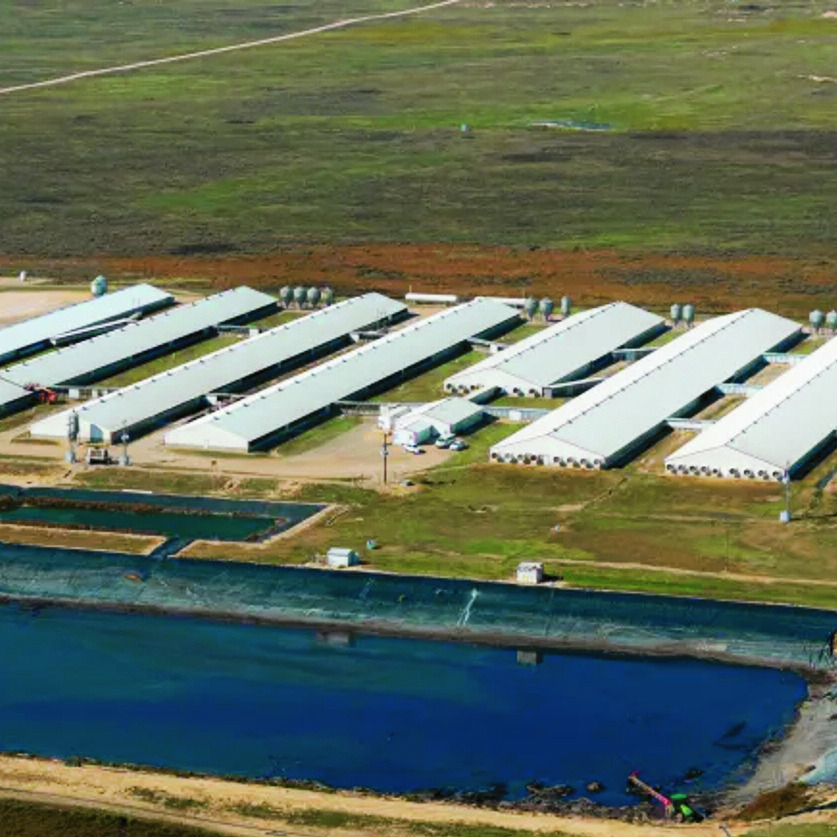
The carve-outs specifically exempt Smithfield Foods, the only Chineseowned company with farmland in Oklahoma. Smithfield Foods, owned by China’s WH Group, is not affected by the restrictions and continues to raise hogs on roughly 2,575 acres in northwest Oklahoma.
Oklahoma’s restrictions mirror a broader national movement in mostly Republican states to curb foreign farmland ownership, driven by security concerns over countries the government deems “hostile.” Yet, unlike states such as Arkansas, Oklahoma lawmakers have shown little interest in forcing Chinese-owned companies already operating in the state to divest or limit their ability to expand.
In 2023, Arkansas Attorney General Tim Griffin ordered the agrichemical firm Syngenta, owned by the Chinese conglomerate ChemChina, to sell its 160-acre research site and fined the company $280,000. The move followed a new state law restricting foreign investments from certain countries.
Arkansas Gov. Sarah Huckabee Sanders touted the decision during a press conference announcing the Trump Administration’s National Farm Security Action Plan, a twelvepage outline aimed at “addressing the imperative for agriculture security in America.”
“I’m so proud of the fact that Arkansas was the first state in the country to kick a Chineseowned company off of our farmland and out of our state,” Sanders said at the press conference in July. “And we made them pay for it. Very Trump-esque.”
During the same press conference, Trump trade adviser Peter Navarro brought up Smithfield Foods, noting that after its purchase by the WH Group, it “now basically controls an eighth of the world’s pork supply.” Counties where Smithfield operates in Oklahoma — Beaver, Harper, and Ellis — are even highlighted on a map included in Trump’s plan. Neither the plan nor those involved in its rollout specified any steps they might take to force Smithfield to divest.
Oklahoma Senate Bill 212 expanded existing restrictions on foreign ownership of farmland.
The law, which took effect in November 2023 — around the same time Arkansas ordered Syngenta to divest — could have impacted Smithfield Foods’ operations in Oklahoma. But the following year, lawmakers added an exception: landownership restrictions do not apply to foreign companies that have an agreement with the Committee on Foreign Investment in the U.S. (CFIUS).
CFIUS is an interagency committee that reviews foreign investments in American companies and real estate to see if they pose national security risks. It can approve, block, or require changes to deals to protect U.S. interests.
WH Group’s 2013 acquisition of Smithfield was cleared by CFIUS, effectively shielding it from Oklahoma’s foreign ownership restrictions.
“We’re honoring the Constitution by those international corporations being vetted by the federal government,” says Oklahoma State Sen. Brent Howard, a Republican from Altus who introduced the legislation that shielded Smithfield.
Smithfield Foods has repeatedly rejected claims of “infiltration” of the U.S. pork industry by the Chinese Communist Party, emphasizing that it is managed by American executives. “We currently own approximately 85,000 acres of farmland [in the U.S.], and that number has declined considerably since the 2013 WH Group acquisition,” says Ray Atkinson, a senior director at Smithfield Foods. “The farmland we own does not present a national security risk and represents less than 1/100th of one percent of all American farmland.”
Enforcement remains selective During a September hearing at the Oklahoma State Capitol, a handful of lawmakers and state officials convened to discuss the perceived threat of the Chinese Communist Party in the state. Guest speakers at the hearing included Jan Jekielek, a journalist and editor for the far-right media outlet The Epoch Times, and Tom Rawlings, policy director of State Shield — both outspoken anti-China organizations.
Although the guest speakers provided no concrete examples of Chinese interference in state politics, they advocated for a state-level Foreign Agents Registration Act, which would require anyone acting on behalf of foreign governments to disclose their ties.
During his presentation, Brad Clark, general counsel with the Oklahoma attorney general’s office, turned the discussion to farmland. Clark explained how the new laws can bolster the state’s crackdown on illegal marijuana operations, some of which are run by Chinese individuals.
After Oklahoma legalized medical marijuana in 2018, the industry has drawn an influx of out-ofstate growers. Alongside that growth, there have been reports of labor exploitation and illegally operated farms, including some linked to Chinese organized crime.
Clark says the attorney general’s office currently has 150 pending cases involving illegal marijuana farms. But in an interview with Investigate Midwest, he did not specify if any of those cases involve Chinese nationals or illegally owned farmland, citing the ongoing nature of the investigations.
The office says it has no closed cases related to illicit land use.
Absent from the discussion was Smithfield Foods, the only Chineseowned company that has lobbied state officials nationwide while also owning farmland in Oklahoma.
Investigate Midwest is an independent, nonprofit newsroom. Our mission is to serve the public interest by exposing dangerous and costly practices of influential agricultural corporations and institutions through in-depth and data-driven investigative journalism. Visit us online at www.investigatemidwest. org